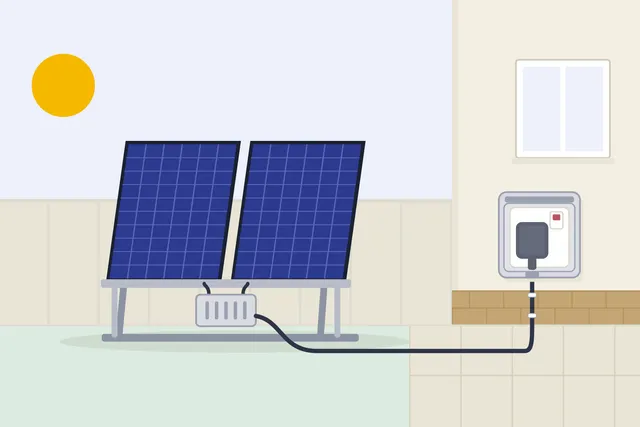
The 800 W limit explained: inverter watts vs panel watts
The 800 W cap is on what the inverter feeds your home, not the panels. How to read a kit's watts, 800 VA and 3.5 A, and what the ENA register shows.
Yes in England, Wales and Scotland since 27 Aug 2026; not yet in Northern Ireland. Every rule with its official source and the date we checked it.
Yes, in England, Wales and Scotland. Since 27 August 2026 you can buy and use a plug-in solar kit that feeds at most 800 W into your home, meets the government’s product specification and is listed as “Compliant” on the ENA Type Test Register. You must register it before you start using it. It is not yet allowed in Northern Ireland, and batteries are not covered.
Based on: SI 2026/848, DESNZ product spec v2 and Ofgem's G98 decision, checked 11 October 2026
Each rule below links to the official document it comes from. Where a point rests on official guidance rather than the legal text, we say so. See what changed and when in our rules log. Written from official sources (evidence: researched). This is general information, not legal advice.
| Question | Answer | How sure we are |
|---|---|---|
| Where? | England, Wales and Scotland. Not Northern Ireland. | Confirmed in the law |
| How much power? | At most 800 W into your home’s wiring (the product spec also says 800 VA and 3.5 A). | Confirmed in the law and spec |
| Which kits? | Only kits built to the Interim Product Specification v2 and shown as Compliant on the ENA register. | Confirmed in the law and spec |
| How many? | One kit per household, for now. | Confirmed in the network rules (G98) |
| Tell anyone? | Register your kit before you use it. | Duty confirmed by Ofgem; timing from official guidance |
| Batteries? | Not covered. Plug-in batteries and battery kits are excluded. | Confirmed in the law, spec and Ofgem decision |
Plug-in solar rules sit in three layers. Knowing which layer a rule comes from tells you how likely it is to change.
Plug-in solar became legal to buy and use in England, Wales and Scotland on 27 August 2026, under the Plugs and Sockets etc. (Safety) Regulations 1994 and Electricity Safety, Quality and Continuity Regulations 2002 (Amendment) Regulations 2026 (SI 2026/848).
The regulations were made on 16 July 2026. They change the plug safety rules (so a kit can have a normal 13 A plug) and the electricity supply rules (so it can be connected and used). The law defines a plug-in microgenerator as having a maximum AC output of no more than 800 watts, and excludes devices designed to draw power from your home to store for later (SI 2026/848).
The law only covers kits built to the government’s Plug-in Solar Device Interim Product Specification (version 2, July 2026). A kit that doesn’t meet it isn’t covered, whatever the listing says (DESNZ product spec v2).
The 45-page specification from the Department for Energy Security and Net Zero (DESNZ) sets out what a kit must include, how it’s tested and labelled, and what its instructions say. The earlier version 1 has been withdrawn, so ignore anything that relies on it (gov.uk, plug-in solar consultation).
Small generators that connect to the grid, from rooftop solar to plug-in kits, are covered by a network code called Engineering Recommendation G98. Ofgem approved a change to G98 to allow plug-in solar (Ofgem G98 decision). Three rules come from this layer:
Network codes can be changed more easily than law, which is why we say “for now” about the one-kit limit.
The rules that allow you to connect and use a plug-in solar kit apply in England, Wales and Scotland (Great Britain) (SI 2026/848).
| England, Wales, Scotland | Northern Ireland | |
|---|---|---|
| Plug safety change (13 A plug allowed) | Yes | Extends UK-wide, but see the next row |
| Can you connect and use a kit? | Yes, from 27 Aug 2026 | No, not yet |
| Network rules | G98 (as amended) | G98/NI, handled separately |
| Who decides | UK Government (done) | Northern Ireland Executive |
We found no Northern Ireland change as of 10 October 2026 and keep checking weekly. A July 2026 news report said Belfast households could use kits from 27 August; that contradicts the government’s impact assessment, and we treat it as wrong.
The limit is on the output into your home, not on the panels:
So a kit with two 445 W panels (890 W in total) can be within the spec if its inverter output stays within 800 VA and 3.5 A. On bright summer middays the inverter caps the output; see how much electricity plug-in solar generates. Inverter watts, panel watts and what the register shows: the 800 W limit explained.
Before you buy, check the kit (1) states it complies with the Plug-in Solar Device Interim Product Specification, (2) is listed as compliant on the ENA Type Test Register, (3) has a moulded 13 A plug with a fuse of 5 A or less, and (4) comes with its own mounting kit and a consumer-unit label (DESNZ product spec v2).
Every legal kit must be type-tested to the G98 network standard and shown as “Compliant” on the Energy Networks Association’s Type Test Register before it can be sold. Being listed isn’t enough on its own: the entry has to say Compliant (DESNZ product spec v2).
The register is public and needs no login. As of 11 October 2026, the ENA register listed 120 plug-in solar kits as Compliant from about 26 manufacturers, out of 133 plug-in solar entries. Always check the exact model yourself, because entries change (ENA Type Test Register).
That includes kits from German shops and online marketplaces. Step by step: how to check a plug-in solar kit is legal.
The product spec already allows one device per final circuit, but says the G98 limit applies until G98 is amended (DESNZ product spec v2).
What counts as a household? The spec defines it as a single home with its own electricity supply and consumer unit. In a block of flats or a converted house, each flat with its own consumer unit counts separately.
Already have rooftop solar? A plug-in kit can still be allowed, but only if your total generation stays within the G98 limit (16 A per phase). Check with your installer or network operator first (Ofgem G98 decision).
Plug the kit into an ordinary wall socket on a socket circuit, not a lighting circuit or a spur to a cooker or boiler (DESNZ product spec v2).
Your consumer unit: the official spec asks for modern residual current protection, such as RCBOs on each circuit. Set-ups with ordinary breakers (MCBs) behind a shared RCD “may also be acceptable”, but the government is still testing this. If you have an old fuse box with rewireable fuses, or you’re unsure, get a qualified electrician to check before installing (DESNZ product spec v2). The Energy Saving Trust’s checklist, made with DESNZ, says to test your RCD’s button every six months while the panels are generating, and not to install plug-in solar if your consumer unit uses older-style fuses (EST checklist).
RCD type (safety charity advice, not law): Electrical Safety First says “homes with Type AC RCDs should not use plug-in solar systems without first upgrading to a minimum Type A bidirectional RCD on those circuits” (Electrical Safety First). This goes further than the government spec, which doesn’t name an RCD type. The type is usually printed on the device in your consumer unit; if you can’t tell, ask a registered electrician.
More: is plug-in solar safe?
The duty: you must register your kit so your local electricity network operator (DNO) knows it’s there, and tell them again if you permanently remove it. Your kit’s instructions must include a link or QR code explaining how (Ofgem G98 decision). Because you’re allowed to install the kit yourself, the duty falls on you, not on an installer.
When: register your kit before you start using it: install it, register it, then switch it on. The official guidance says registering is a legal requirement, and it takes a few minutes. Electricity North West, a network operator, says: “You’re legally required to register any plug-in solar panel devices before you use them in the UK” (Electricity North West). The Energy Saving Trust’s guidance says the same (Energy Saving Trust).
Where: register at the UK Plug-in Solar Registration website (myplugin.solar). This is the link given by the Energy Saving Trust’s government-backed guidance and by network operators. Have your name, postcode, and your kit’s make and model ready. Save or screenshot the on-screen confirmation, because you won’t get an email (EST checklist). Some guides call this registering “on the ENA website”; it’s the same step.
If you remove the kit: you’re also expected to tell your network operator. Check the registration site for how.
How sure are we? The duty to notify is confirmed in Ofgem’s decision. The “before use” timing and the registration website come from official consumer guidance and a network operator’s page; we haven’t yet read the amended G98 text itself.
The exclusion is wider than some early reports suggested: the product spec excludes any plug-in solar kit integrated with a battery, not just grid-charging ones, and kits must warn against use with battery storage (DESNZ product spec v2). Ofgem says plug-in electricity storage devices remain prohibited from being sold, supplied or used in the UK (Ofgem G98 decision).
Some products are listed on the ENA register as solar-only kit configurations: compliant as a solar-only kit, but adding a battery isn’t covered by the current rules.
Renting or in a leasehold flat? The new law doesn’t give you a right to install. Check your tenancy or lease and ask your landlord, freeholder or managing agent before you buy. Get the answer in writing, including who pays for what (DESNZ product spec v2). Leaseholders: plug-in solar in flats and leasehold homes.
Germany changed its tenancy and condominium law in October 2024 to make it harder to refuse plug-in solar. The UK hasn’t, so permission rules still apply here, as the government’s impact assessment notes (DESNZ impact assessment). London Fire Brigade adds: “Permission may be required under the terms of your tenancy agreement” (London Fire Brigade). See our guide for renters.
Tell your home insurer (and your building’s insurer, if you’re in a flat) before you install. The product spec makes checking this your responsibility (DESNZ product spec v2).
England. In England, planning rules updated on 27 August 2026 cover plug-in solar under the existing “permitted development” rights for home solar, so most typical set-ups on a house or in a garden shouldn’t need a planning application if they stay within the limits. Plug-in panels must not be fitted to a wooden wall, wooden balcony, wooden fence or gate, or timber-clad walls. Listed buildings, and walls facing a road in conservation areas, are excluded. Fixings on a wall or balcony may stick out no more than 0.4 m (0.2 m if it’s next to a road). If your home is listed, in a conservation area or a World Heritage Site, or you’re unsure, check with your council before buying (SI 2026/896).
The change is SI 2026/896, in force from 27 August 2026. Flats have their own limits, and the lease and building-safety points above still apply, so don’t assume a balcony set-up is automatically allowed.
Wales and Scotland. Wales and Scotland have their own planning rules and haven’t made a plug-in-specific change. Check your council’s guidance (Planning Portal for Wales, ePlanning Scotland) before fixing panels to your home. A freestanding kit you can lift away is the lower-risk option (EST checklist).
Everywhere, the product spec makes you responsible for getting any planning permission and listed building consent you need.
Plugging into an existing socket needs no building work. Adding a new outdoor socket, or changing a circuit or breaker, is electrical work for a qualified electrician and may fall under building regulations (DESNZ impact assessment).
Yes. You’re allowed to install a compliant kit yourself. An electrician is only required where the instructions say so (for example, for circuit changes or older fuse boxes) (Ofgem G98 decision). The government decided that mandatory inspections or professional installation would not be proportionate (DESNZ Government Response). Step by step: how to install a plug-in solar kit, step by step.
Bring in a qualified electrician for an old fuse box (or if you’re unsure what you have), a new outdoor socket or any circuit change, and consider one above 960 W of panels. Electrical Safety First goes further and recommends an assessment by a competent electrician “registered with a competent persons scheme before purchasing or using a plug-in solar system” (Electrical Safety First).
Don’t count on being paid for electricity you export. The Smart Export Guarantee needs an MCS-certified installation, which plug-in kits normally don’t have. Spare power simply flows to the grid unpaid unless your supplier offers something else (DESNZ impact assessment).
A few suppliers offer export payments to plug-in users on their own terms. If export pay matters to you, ask your supplier before you buy. See are plug-in solar panels worth it?
As of 11 October 2026:
When any of these changes, we record it in the rules log.
Rules checked: . This is general information, not legal advice. Check your tenancy or lease, and your council for planning. How we research.
The Wattleigh Editorial Team researches and writes every guide on this site. We work from official sources (legislation.gov.uk, DESNZ, Ofgem, the Energy Networks Association, Electrical Safety First) and show the date we last checked the rules on each page. Our guides are researched, not hands-on tested.
The 800 W cap is on what the inverter feeds your home, not the panels. How to read a kit's watts, 800 VA and 3.5 A, and what the ENA register shows.
Official guidance says registering a plug-in solar kit is a legal requirement, done before you switch it on. Where to register and what you need.
No. Plug-in batteries and battery kits aren't covered by the 2026 rules. What the law says, how to spot 'battery ready' listings, and what to do instead.
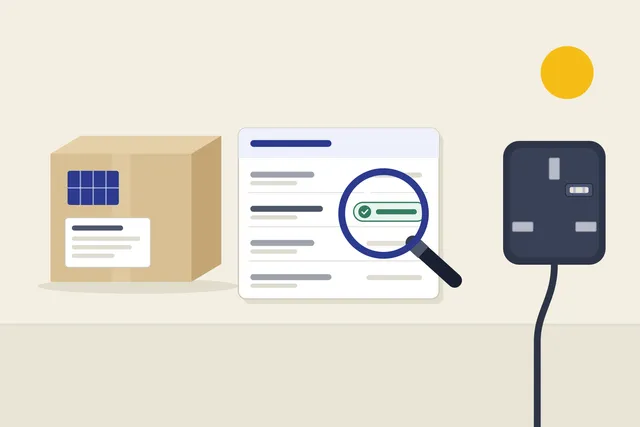
Four checks in five minutes: the UK spec statement, Compliant on the ENA register, the plug and fuse, and the mounting kit. Plus red flags on listings.