Is plug-in solar safe? Sockets, extension leads and wiring
What a compliant plug-in solar kit does to protect you, what to check at your consumer unit, where not to fit it, and what never to do.
How we're paid: We don't earn from any retailer on this page yet. If that changes, this line will say so. How we make money
Quick answer
Is plug-in solar safe? The short answer: a compliant kit plugged directly into a sound wall socket on a socket circuit is designed to be safe.
Based on: DESNZ product spec v2 and Electrical Safety First, checked 11 October 2026
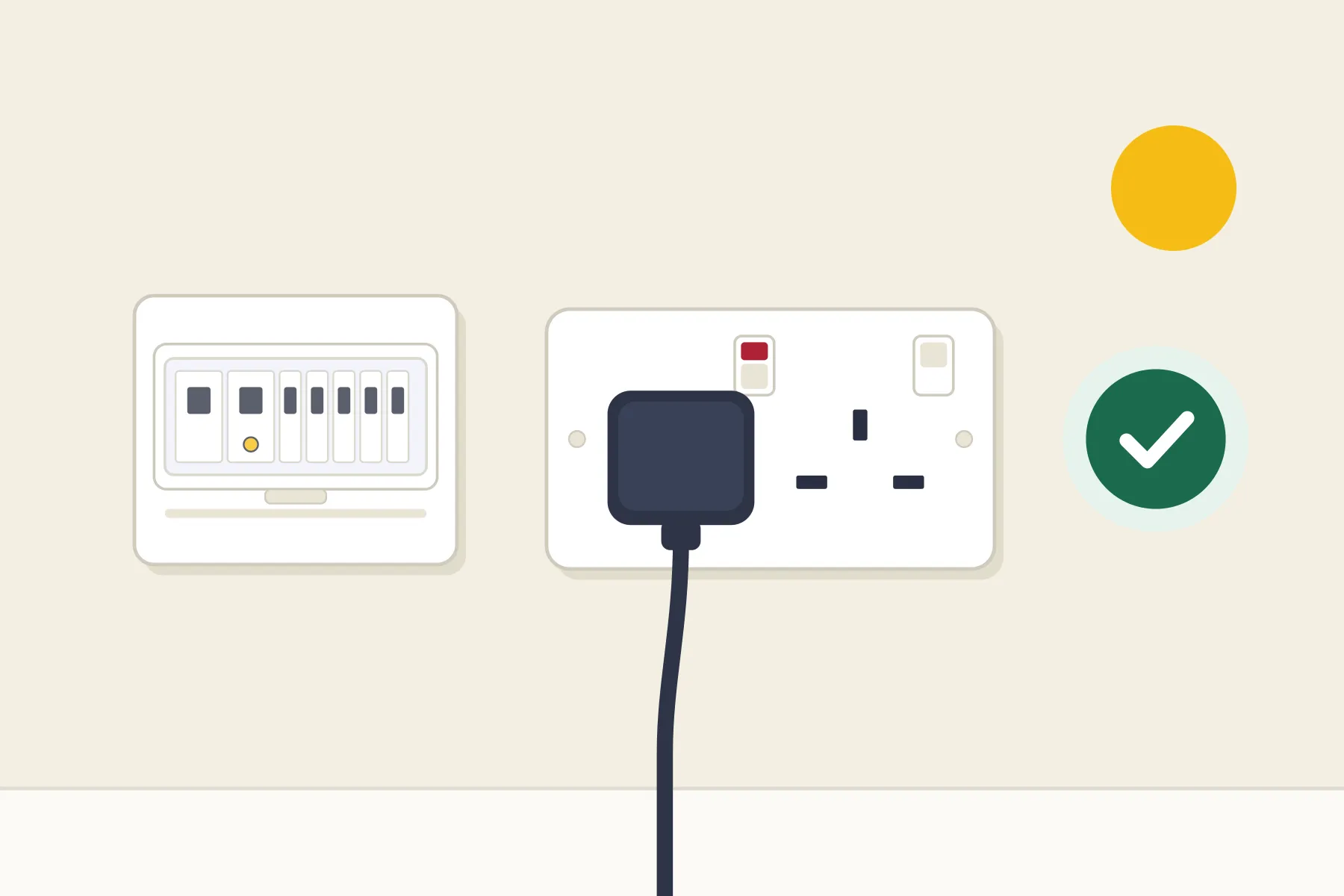
The government’s product spec requires it to switch off within a tenth of a second if the grid goes down, and its plug pins must drop to a safe voltage just as fast (DESNZ product spec v2, 6.2.3.3.3). The risks come from how it’s connected and where it’s mounted. Never use an extension lead or adaptor. Check that your consumer unit has modern RCD protection. Get a qualified electrician to look first if you have an old fuse box or aren’t sure. Electrical Safety First goes further and recommends an electrician’s check before you buy (Electrical Safety First).
New to plug-in solar? Start with the complete guide.
What a compliant kit does to keep you safe
Everything in this section applies only to kits that meet the government’s Plug-in Solar Device Interim Product Specification (version 2, July 2026). The law only covers kits built to that spec. A kit that doesn’t meet it isn’t covered, whatever the listing says (SI 2026/848). Every legal kit must also be shown as “Compliant” on the Energy Networks Association’s Type Test Register before it can be sold (ENA Type Test Register; product spec v2, section 7).
| Protection | What the spec requires | Why it matters |
|---|---|---|
| Switches off when the grid goes down (“anti-islanding”) | The inverter must disconnect from the mains within 100 milliseconds | It won’t keep feeding power into your wiring or the network during a power cut |
| Safe plug pins | After unplugging, the voltage at the plug pins must fall below 34 V within 100 milliseconds | Reduces the risk of a shock from the pins of an unplugged kit |
| Extra contact protection | A shutter, lock or cover on the plug, or an automatic cut-off that removes dangerous voltage within 2 seconds of unplugging | A second layer of protection for the plug |
| Fused, moulded plug | A non-rewireable moulded UK plug with a fuse of 5 A or less, and partially insulated pins | You can’t rewire it, and the fuse limits the current |
| Limited output | No more than 800 VA and 3.5 A fed into your wiring (the law caps rated output at 800 W) | Keeps the extra current on a socket circuit small |
| Limited DC leakage | Smooth DC leakage into the mains must not exceed 5 mA | Limits the kit’s effect on your RCD. DESNZ is still testing whether this level can affect older Type AC RCDs (see below) |
| Weatherproofing | Outdoor parts at least IP55 | Protection against dust and water jets |
| Panel fire performance | The panel’s outermost substantial layer (usually the backsheet) must reach a fire performance equivalent to Euroclass B-s3, d2 | A set level of fire performance for the panel |
| Network type test | Type-tested to the G98 network standard | Meets the network operators’ rules for connecting to the grid |
Source for every row: DESNZ product spec v2, sections 4.1, 5.4, 5.7, 6.2.3.2, 6.2.3.3.3, 6.3, 6.4.1 and 7. The “Why it matters” column is our plain-English explanation.
One thing a kit does not have to include is an RCD. The spec instead requires the kit’s instructions to tell you to check your home has modern residual current protection (product spec v2, 8.3.2). That’s why the next section matters.
How to check a kit before buying: how to check a kit is compliant.
Before you plug in: check your consumer unit
Your consumer unit (fuse box) is usually near your electricity meter.
- What the official spec says: your home should have modern residual current protection (RCBOs). Circuits with MCBs and an RCD upstream may also be acceptable, but DESNZ says this is still being tested. If you have an old fuse box with rewireable fuses, if the unit isn’t clearly labelled, or if you’re unsure, get a qualified electrician to check before installing (product spec v2, 8.3.2 and 8.3.3).
- What the government-backed checklist adds: the Energy Saving Trust’s checklist, made with DESNZ, says that if your consumer unit uses older-style fuses, you shouldn’t install plug-in solar panels (EST checklist).
- What Electrical Safety First recommends: the charity says “we recommend households have at least a Type A bidirectional RCD protecting circuits intended for use with plug-in solar panels.” It also says “homes with Type AC RCDs should not use plug-in solar systems without first upgrading to a minimum Type A bidirectional RCD on those circuits” (Electrical Safety First). This is the charity’s recommendation, which goes further than the government spec. It is not a legal requirement. The RCD type is usually printed on the device in your consumer unit. If you can’t tell, ask a registered electrician.
- An electrician’s check first: Electrical Safety First recommends that households have their electrical installation “assessed by a competent electrician registered with a competent persons scheme” before buying or using a kit, particularly in older properties (Electrical Safety First).
- Bigger kits: if your kit has more than 960 W of panels, the official spec says you should consider having a qualified electrician check your wiring first (product spec v2, 4.1).
Where to plug it in
- An ordinary wall socket on a socket circuit. Plug the kit into an ordinary wall socket on a socket circuit, not a lighting circuit or a spur to a cooker or boiler (product spec v2, 8.3.3). The EST checklist says the circuit should have no lighting or hard-wired appliances on it (EST checklist). The kit’s instructions must explain how to tell which sockets share a circuit. If you’re unsure, ask a qualified electrician (product spec v2, 8.3.2).
- A sound socket only. The spec says the kit must not be connected to a damaged, degraded or non-compliant socket, and that you should get a qualified electrician to inspect it if you have any doubt (product spec v2, 8.3.1). If a socket is cracked, scorched, loose or feels warm, don’t use it.
- One kit per household. Right now you can connect one plug-in solar kit per household (Ofgem G98 decision, p.3). Electrical Safety First says: “Installing multiple units could reduce the effectiveness of protective devices” (Electrical Safety First).
- Outdoor sockets. A new outdoor socket is electrical work for a qualified electrician and may fall under building regulations (DESNZ impact assessment, para 24). Outdoor sockets must be weatherproof: the product spec sets at least IP55 for outdoor plugs and sockets (product spec v2, 5.4), and the EST checklist says at least IP65 and fitted by a qualified electrician (EST checklist).
Never do these
Where not to mount it
- Not on timber balconies, timber cladding or composite cladding (aluminium composite, metal composite or high-pressure laminate), or on a building under external wall remediation works (product spec v2, 5.8).
- Not where it blocks escape or rescue routes, or on shared balconies. The spec makes you responsible for keeping escape and rescue paths clear (product spec v2, 8.3.2). London Fire Brigade says solar equipment shouldn’t block shared balconies, walkways, windows or fire escape routes (London Fire Brigade).
- Not on a wall that forms the boundary between two homes, and not where it could help fire spread along walls or balconies to a neighbour’s home (product spec v2, 8.3.2).
- Use the mounting system supplied with the kit. The spec describes the mount as part of the kit, with the maker showing by calculation that it’s safe for wind and snow loads. We only recommend kits that come with the maker’s own mount. Mounting that relies only on cable ties, rope, string, tape, bungee cords or straps is not allowed, and any attachment must be reversible and non-permanent (product spec v2, 5.5.1 and 8.3.2). London Fire Brigade advises using only brackets, fixings and accessories recommended by the manufacturer (London Fire Brigade).
- Keep combustible materials away from the panels, inverter and connections, as London Fire Brigade advises (London Fire Brigade).
- In England, planning rules also exclude plug-in solar on wooden walls, balconies, fences and gates, and on timber-clad walls (SI 2026/896). Balcony specifics: balcony solar panels.
Using it safely day to day
- Test your RCD while the panels are generating. The spec says to press the test button on your RCD or RCBO now and then while the kit is producing power. If it doesn’t trip straight away, contact a qualified electrician (product spec v2, 8.3.4). The EST checklist says to test every six months, and to unplug the kit if the breaker doesn’t trip (EST checklist).
- Fit the consumer-unit label. Compliant kits come with a label to stick at or near your consumer unit, so anyone working on your electrics knows a plug-in solar device is there (product spec v2, 8.2.3.1).
- Look after the lead. Route it as the kit’s instructions say, so it can’t be tripped over, pinched in a door or window, or damaged. London Fire Brigade warns that damaged cables can overheat or short circuit (London Fire Brigade; product spec v2, 8.3.2).
- Know the warning signs. London Fire Brigade advises stopping use straight away if you notice a burning smell, overheating, buzzing, visible damage or repeated tripping. If you smell burning, call 999. In a fire, don’t touch the system, get to safety, call 999 and tell the fire service you have solar panels (London Fire Brigade).
- Register it. Register your kit before you start using it: install it, register it, then switch it on. Official guidance says registering is a legal requirement. Use the UK Plug-in Solar Registration website (myplugin.solar), the link given by network operators and by the Energy Saving Trust’s government-backed guidance (Electricity North West; EST checklist).
When to call a qualified electrician
Already have rooftop solar? A plug-in kit can still be allowed, but only if your total generation stays within the G98 limit (16 A per phase). Check with your installer or network operator first (Ofgem G98 decision, p.3).
Who should not install a kit yet
- Homes with an old rewireable fuse box: the EST checklist says don’t install (EST checklist). Get the consumer unit checked first.
- Homes with a Type AC RCD on the circuit: Electrical Safety First says upgrade to at least Type A bidirectional first (Electrical Safety First).
- Timber balconies, timber or composite cladding, or buildings under cladding remediation: not permitted (product spec v2, 5.8).
- Anyone in Northern Ireland: not yet allowed (see below).
- Anyone who wants to add a battery: not covered by the rules.
What happens in a power cut?
The kit switches itself off. A compliant inverter must disconnect from the mains within 100 milliseconds if the grid goes down, so it doesn’t feed power back into the network (product spec v2, 6.2.3.3). This protects people working on the network. It also means a plug-in kit gives you no backup power in a power cut.
Can I install it myself?
You’re allowed to install a compliant kit yourself (Ofgem G98 decision, p.6). An electrician is only required where the instructions say so (for example, for circuit changes or older fuse boxes). “Installing it yourself” means fitting the supplied mounting, connecting the kit’s own parts as its instructions say, and plugging into an existing socket. It does not mean any wiring work. The full order, with stop points: how to install a plug-in solar kit, step by step.
What the experts say
There are two views, and both are worth knowing:
- The government decided that mandatory inspections or professional installation would not be proportionate for this kind of low-power product, and relies on the product spec and clear instructions instead (DESNZ Government Response, p.15). DESNZ also says it is testing whether 5 mA of DC leakage can still affect older Type AC protective devices, and will review the limit when results are in (Government Response, p.46).
- Electrical Safety First recommends an assessment by a registered electrician first, particularly in older properties, and at least a Type A bidirectional RCD on the circuit. It warns: “Don’t assume ‘plug-in’ means it’s suitable for every home.” It also advises buying from reputable retailers rather than third-party sellers on online marketplaces (Electrical Safety First). Before the final rules were published, it joined the ECA, the IET, NICEIC and SELECT in a joint statement (9 June 2026) saying “important questions still need to be answered before plug-in solar panels are adopted on a large scale”, including how kits would work with existing home wiring (IET press release).
Our view: if you’re in any doubt about your wiring, get it checked by a qualified electrician before you buy.
Northern Ireland
Next step
- Check a kit before you buy: how to check a kit is compliant
- See kits that pass the rules: best plug-in solar kits
- All the rules in one place: plug-in solar rules
This page’s safety wording was checked in-house by the Wattleigh team against our rules sheet (see the rules log), Electrical Safety First and Energy Saving Trust guidance. It has not been reviewed by an external electrician. See How we research for how we check safety wording.
Common questions
- Can plug-in solar catch fire?
- Any electrical product can fail. Compliant kits have to meet set standards, including a fused moulded plug, limited output and a fire performance level for the panels. The spec and fire service advice focus on how a kit is connected and mounted: no extension leads or adaptors, a sound socket, nothing combustible nearby, and never on timber balconies or combustible cladding.
- Can I use an extension lead or a cable reel?
- No. The product spec says extension cables, multi-way adaptors, RCD adaptors and travel adaptors are not permitted, and Electrical Safety First adds cable reels.
- Do I need an RCD?
- The spec says your home should have modern residual current protection (RCBOs). MCBs with an upstream RCD may also be acceptable, but DESNZ is still testing this. Electrical Safety First recommends at least a Type A bidirectional RCD on the circuit and says homes with Type AC RCDs should upgrade before using plug-in solar. If you're unsure, ask a registered electrician.
- Is it safe in an old house?
- If your consumer unit has old rewireable fuses, the government-backed checklist says not to install. Electrical Safety First recommends an electrician's assessment before buying, particularly in older properties.
- Is it safe for people working on the grid during a power cut?
- That's what anti-islanding is for. A compliant kit must disconnect within 100 milliseconds when the grid goes down.
- Can children touch the plug when it's unplugged?
- Compliant plugs must drop below 34 V at the pins within 100 milliseconds of unplugging, and have a shutter, lock or automatic cut-off as extra protection. Still treat it like any mains plug and keep it out of reach.
Keep reading
How to install a plug-in solar kit, step by step
The safe, legal order: checks first, the kit's own mount, register before use, then straight into a wall socket. With stop points at each step.
Balcony solar panels in the UK: what actually works
Which UK balconies suit a plug-in solar kit, how much a vertical panel really makes, fixings, wind, planning and who to ask first.
Best plug-in solar panels in the UK: kits that pass our rules check
Kits we could match exactly to a Compliant ENA register entry and order in the UK: inverter and panel watts, price with seller and date, modelled output.
The Wattleigh Editorial Team researches and writes every guide on this site. We work from official sources (legislation.gov.uk, DESNZ, Ofgem, the Energy Networks Association, Electrical Safety First) and show the date we last checked the rules on each page. Our guides are researched, not hands-on tested.