The 800 W limit explained: inverter watts vs panel watts
The 800 W cap is on what the inverter feeds your home, not the panels. How to read a kit's watts, 800 VA and 3.5 A, and what the ENA register shows.
How we're paid: We don't earn from any retailer on this page yet. If that changes, this line will say so. How we make money
Quick answer
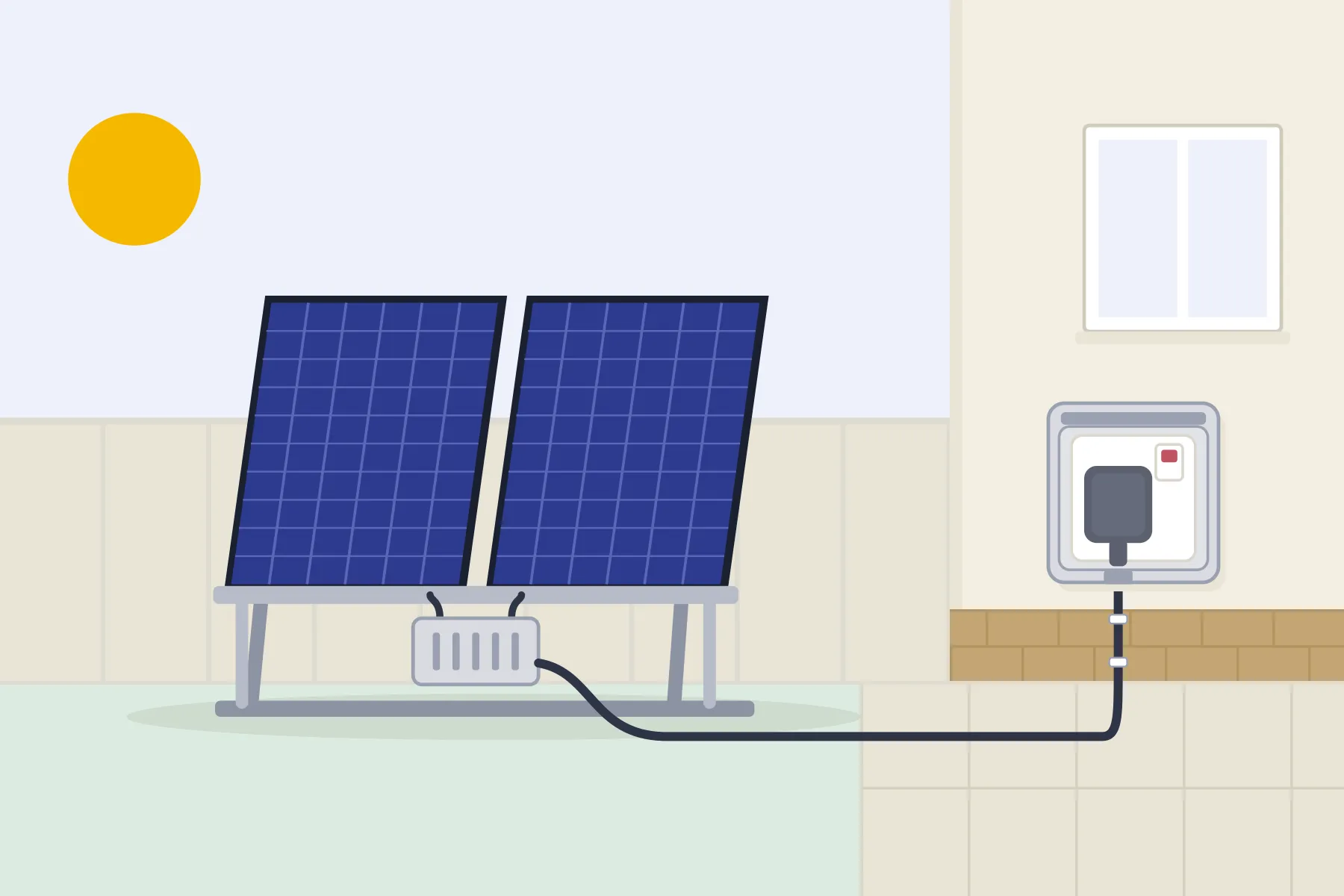
The UK’s 800 W limit for plug-in solar is on what the kit’s inverter feeds into your home’s wiring, not on the panels (SI 2026/848). A legal kit’s inverter can feed at most 800 W into your home’s wiring, and the product spec also caps it at 800 VA and 3.5 A. The kit can include up to 2,000 W of panels, up to four of them. So an “890 W” or “1,260 W” kit can be legal: the panel number is bigger, but the inverter still caps what reaches your sockets. If your kit has more than 960 W of panels, the official spec says you should consider having a qualified electrician check your wiring first (DESNZ product spec v2).
Based on: SI 2026/848 and the DESNZ product spec v2, checked 2 November 2026
Rules checked: . ENA register snapshot: 2 November 2026. Written from official sources by the Wattleigh Editorial Team (evidence: researched; we haven’t tested kits). General information, not legal advice. All the rules in one place: is plug-in solar legal in the UK?
Shopping for an 800 W kit? See the kits that pass our rules check, with inverter watts and panel watts side by side.
The short answer
| What’s limited | The limit | Where it comes from |
|---|---|---|
| Power the inverter feeds into your home (AC) | 800 W | The law (SI 2026/848) |
| Apparent power and current into your home | 800 VA and 3.5 A | Product spec v2, 4.1 |
| Total panel power (DC) | 2,000 W, up to four panels | Product spec v2, 4.1 and 4.2.2 |
| Advice to get your wiring checked | Above 960 W of panels | Product spec v2, 4.1 |
| Number of kits | One per household, for now | Network rules (G98) |
Sources: SI 2026/848; DESNZ product spec v2; Ofgem G98 decision.
New to plug-in solar? Start with our plug-in solar guide.
What the law and the spec actually limit
The law defines a plug-in microgenerator as a device that “has a maximum rated alternating current output not exceeding 800 watts” (SI 2026/848). Alternating current is what comes out of the inverter and into your sockets, so the law limits the inverter side.
The product spec (the government’s Interim Product Specification, version 2) adds two more caps. Section 4.1 says kits “shall be designed such that the maximum apparent power Smax supplied to the mains installation does not exceed 800 VA and the maximum current does not exceed 3.5 A.” The spec defines Smax as the “Highest 10-minute average value of the measured apparent output power”, so it’s a 10-minute average, not an instant reading (DESNZ product spec v2).
The law only covers kits built to that spec. A kit that doesn’t meet it isn’t covered, whatever the listing says.
Panels can add up to more: up to 2,000 W
Kits can include up to 2,000 W of panels (up to four panels), but the inverter still limits what reaches your sockets to 800 W. The spec also says no more than two panels may be connected in series in any string, the open-circuit voltage at the inverter inputs must not exceed 120 V DC, and “Y-connectors shall not be used” (DESNZ product spec v2).
The government’s consultation response says it will keep the 2,000 W panel cap “under review”, but that “it will be retained in this interim IPS” (Government Response, July 2026).
So a kit with two 445 Wp panels (890 Wp in total) is within the spec, provided its inverter output stays within 800 VA and 3.5 A and it meets the rest of the spec. More than 800 W of panels doesn’t make a kit illegal.
How to read a kit’s watts
A listing that says “800 W” can mean the inverter or the panels. Check both numbers.
| Term | What it measures | Where you’ll see it | Limit |
|---|---|---|---|
| W (AC) | Power the inverter feeds into your home | Inverter spec sheet, often in its model name | 800 W (law) |
| VA | Apparent power: voltage × current (glossary) | Inverter data sheet, “max apparent power” | 800 VA (spec) |
| A | Current into your socket | Inverter data sheet, “max output current” | 3.5 A (spec) |
| Wp | A panel’s rated output in lab conditions (glossary) | Panel label, kit name (“890W”, “900Wp”) | 2,000 W of panels (spec) |
| kWp | 1,000 Wp | Some listings and yield tools | As Wp |
| kW, registered capacity | The figure on the ENA register entry | ENA Type Test Register | The register’s own field; it isn’t the panel Wp |
Sources: DESNZ product spec v2; ENA Type Test Register.
Three examples from the register
Real entry names from our 2 November 2026 snapshot, all listed as Compliant on that date:
- A single-panel kit. “UKSOL Plug-In Solar Pro Compact 460W Single Panel Ground Mount Kit” (UKSOL/21002/V1/A2), registered at 0.8 kW. The “460W” is the panel, well below the 800 W cap.
- A two-panel kit above 800 Wp. “UKSOL Plug-In Solar Pro Duo 890W Two Panel Ground Mount Kit” (UKSOL/21003/V1/A2), registered at 0.8 kW. The “890W” is the two panels together (2 × 445 Wp). The inverter caps what reaches your sockets at 800 W.
- A kit with a smaller inverter. “475W Modular Solar Unit 400W inverter” (MODUL/21443/V1/A3), registered at 0.4 kW. The panel is 475 W but the inverter is 400 W, so the kit’s output is limited to about 400 W, however bright the day.
Similar names can hide different ratings: Perlight’s “PowerPlug+ 465” (PERLI/21646/V1/A3) is registered at 0.5 kW, its “PowerPlug+ MAX 465” (PERLI/21554/V1) at 0.8 kW. Some names carry both figures: one entry lists “800W” and “PV 910W” in its name, 800 W for the inverter and 910 W for the panels. That entry was Non-compliant in our 15 October snapshot and Compliant on 2 November, a reminder that the status matters more than the numbers, and that it can change (ENA Type Test Register).
Step by step: how to check a plug-in solar kit is legal.
What the ENA register shows
Every legal kit must be type-tested to the G98 network standard and shown as “Compliant” on the Energy Networks Association’s Type Test Register before it can be sold. Being listed isn’t enough on its own: the entry has to say Compliant (DESNZ product spec v2).
On 2 November 2026, 127 kits were listed as Compliant: 114 registered at the full 0.8 kW and 13 at lower ratings (0.34–0.799 kW). Another 9 entries were Non-compliant. Always quote the date, as the register changes (ENA Type Test Register).
Match the whole entry, not just the model number. On 2 November, two entries from different manufacturers shared the same model number, and only one of them was Compliant. Check that the manufacturer and the entry’s reference (such as UKSOL/21002/V1/A2) match the kit you’re buying, and that the entry says Compliant.
Panel watts in entry names. The register has no panel-watts field, so we read the names. Of the 127 Compliant entries, 23 state the whole kit’s panel watts in the name:
| Panel watts stated in the name | Entries |
|---|---|
| 800 W or less (340–530 W) | 11 |
| Above 800 W, up to 960 W (890–920 W) | 9 |
| Above 960 W (1,020–1,260 W) | 3 |
Wattleigh count from the ENA register snapshot of 2 November 2026. “Registered capacity” is the register’s own field (kW); it isn’t the panel Wp. We counted only a figure followed by W or Wp for the whole kit, and left out bare numbers, panel model codes, per-panel figures (such as “2pcs 515W”) and “800W” figures that may describe the inverter (ENA Type Test Register).
Kits with more than 800 W of panels are common, and a bigger panel figure doesn’t mean a bigger inverter: the APsystems “Premium Set Dual-1020W” (ALTEN/21303/V1) names 1,020 W of panels but is registered at 0.799 kW.
Is it worth having more than 800 W of panels?
It depends how the panels face. In the UK, panels spend most of their time well below their Wp rating, so extra panel watts help on dull days, in winter, early and late in the day, and on vertical or east/west set-ups. On a bright summer midday a tilted south-facing kit can hit the cap, and the inverter trims the extra. That’s clipping.
What clipping costs in kWh is covered in bigger panels, same 800 W limit, and our calculator gives a rough estimate. Whether extra panels are worth the price is in how much plug-in solar costs.
If your kit has more than 960 W of panels, the official spec says you should consider having a qualified electrician check your wiring first (DESNZ product spec v2). That’s a line for advice, not a legal limit.
800 W, 800 VA and 3.5 A: why three numbers?
Watts measure the power you can actually use; volt-amperes are voltage multiplied by current. In basic electrical terms, real power in watts can’t be more than apparent power in volt-amperes, so an inverter that stays within 800 VA also delivers no more than 800 W. The 3.5 A cap is about the current flowing into your socket circuit.
The spec caps a kit at 800 VA (averaged over 10 minutes) and 3.5 A. Because current rises as voltage falls, the inverter must limit its output when your mains voltage is low, so it never pushes more than 3.5 A into your wiring (DESNZ product spec v2).
Our arithmetic (Wattleigh’s calculation, not the spec’s). The spec’s nominal supply voltage (Un) is 230 V. We multiply the voltage by 3.5 A to see how much apparent power the current cap allows.
| Mains voltage | 3.5 A works out at | Which cap binds |
|---|---|---|
| 253 V (1.1 Un) | 3.5 × 253 ≈ 886 VA | 800 VA (the current stays below 3.5 A) |
| 230 V (1 Un) | 3.5 × 230 = 805 VA | About equal: 800 VA ÷ 230 V ≈ 3.48 A |
| 216.2 V (0.94 Un) | 3.5 × 216.2 ≈ 757 VA | 3.5 A: output drops to about 757 VA |
| 195.5 V (0.85 Un) | 3.5 × 195.5 ≈ 684 VA | 3.5 A: output drops to about 684 VA |
Which low voltage does the spec test at? It isn’t consistent. Section 6.4.1 tests the inverter “at supply voltages of 0.94 Un, 1 Un and 1.1 Un, where Un is the nominal supply voltage (230V)”. Table 1 says “≤ 3.5 A at reduced voltage (≈0.85 Un)”. We show both and don’t pick one (DESNZ product spec v2).
One kit per household, not per socket
So two 400 W kits on two sockets don’t get round the limit: the second kit isn’t allowed. A household is a home with its own supply and consumer unit, so each flat with its own consumer unit counts separately.
Plug the kit into an ordinary wall socket on a socket circuit, not a lighting circuit or a spur to a cooker or boiler. Never use an extension lead, multi-plug adaptor, RCD adaptor or travel adaptor. Even once G98 allows more, the limit stays at one device per circuit (DESNZ product spec v2). More: is plug-in solar safe?
Already have rooftop solar?
A plug-in kit can still be allowed, but only if your total generation stays within the G98 limit (16 A per phase). Check with your installer or network operator first (Ofgem G98 decision). More: plug-in solar vs rooftop solar.
What 800 W can and can’t power
At full output, a kit supplies up to 800 W towards whatever is running in your home at that moment; anything more comes from the grid as usual, and most of the time the kit makes less. It won’t keep anything running in a power cut: the spec requires the inverter to disconnect from the mains within 100 milliseconds (DESNZ product spec v2). It doesn’t store power for later either: plug-in batteries, and kits with a built-in or add-on battery, aren’t covered by the new rules (SI 2026/848; DESNZ product spec v2). More: can you add a battery to plug-in solar?
Will the limit change?
Two changes are on record, neither to the 800 W figure:
- Panel cap: the 2,000 W cap is “under review” but stays in this interim spec.
- Number of kits: one per circuit is planned, but only once G98 is amended.
Source: Government Response, July 2026.
We haven’t found any official plan to change the 800 W limit itself. Any change will go in our rules log.
Northern Ireland
The August 2026 change does not yet let you use plug-in solar in Northern Ireland. It would need a separate change to Northern Ireland’s own electricity safety regulations, which is a decision for the NI Executive. We’ll update this when that happens (DESNZ impact assessment).
Next step
- Check a kit before you buy: how to check a plug-in solar kit is legal
- Compare kits: best plug-in solar kits in the UK
- See what a kit makes: how much electricity plug-in solar generates
- Register it before use: how to register your kit
Rules checked: . ENA register snapshot: 2 November 2026. We record every rule change in our rules log. General information, not legal advice. How we research.
Common questions
- Is an 890 W or 1,000 W kit legal?
- It can be, if the inverter stays within 800 VA and 3.5 A, the panels total 2,000 W or less, the kit meets the product spec and its register entry says Compliant. Match the manufacturer and the entry's reference, not just the model number.
- Can I have more than 800 W of solar panels?
- Yes, up to 2,000 W and up to four panels. Above 960 W, the official spec says you should consider having a qualified electrician check your wiring first.
- Can I have two 400 W kits?
- No. Right now you can connect one plug-in solar kit per household.
- Is 800 W the same as 800 VA?
- Not quite. The law caps output at 800 W; the spec caps it at 800 VA and 3.5 A. Real power in watts can't be more than volt-amperes, so an inverter within 800 VA also delivers no more than 800 W.
- What happens to power above 800 W?
- The inverter caps it (clipping). See how much electricity plug-in solar generates.
- Will the limit go up?
- No change to 800 W has been announced. The 2,000 W panel cap is under review.
Keep reading
How to register your plug-in solar kit before you use it
Official guidance says registering a plug-in solar kit is a legal requirement, done before you switch it on. Where to register and what you need.
Can you add a battery to plug-in solar in the UK?
No. Plug-in batteries and battery kits aren't covered by the 2026 rules. What the law says, how to spot 'battery ready' listings, and what to do instead.
How to check a plug-in solar kit is legal before you buy
Four checks in five minutes: the UK spec statement, Compliant on the ENA register, the plug and fuse, and the mounting kit. Plus red flags on listings.
The Wattleigh Editorial Team researches and writes every guide on this site. We work from official sources (legislation.gov.uk, DESNZ, Ofgem, the Energy Networks Association, Electrical Safety First) and show the date we last checked the rules on each page. Our guides are researched, not hands-on tested.