How to check a plug-in solar kit is legal before you buy
Four checks in five minutes: the UK spec statement, Compliant on the ENA register, the plug and fuse, and the mounting kit. Plus red flags on listings.
How we're paid: We don't earn from any retailer on this page yet. If that changes, this line will say so. How we make money
Quick answer
Check first: four checks before you buyBefore you buy, check that the kit (1) states it complies with the Plug-in Solar Device Interim Product Specification, (2) is listed as “Compliant” on the Energy Networks Association’s Type Test Register (being listed isn’t enough), (3) has a moulded 13 A plug with a fuse of 5 A or less, and (4) comes with its own mounting kit and a consumer-unit label. If any of checks 1–3 fails, don’t buy it, whatever the listing says. For check 4, we only recommend kits that come with the maker’s own mounting system (more below).
Based on: DESNZ product spec v2 and the ENA Type Test Register, checked 11 October 2026
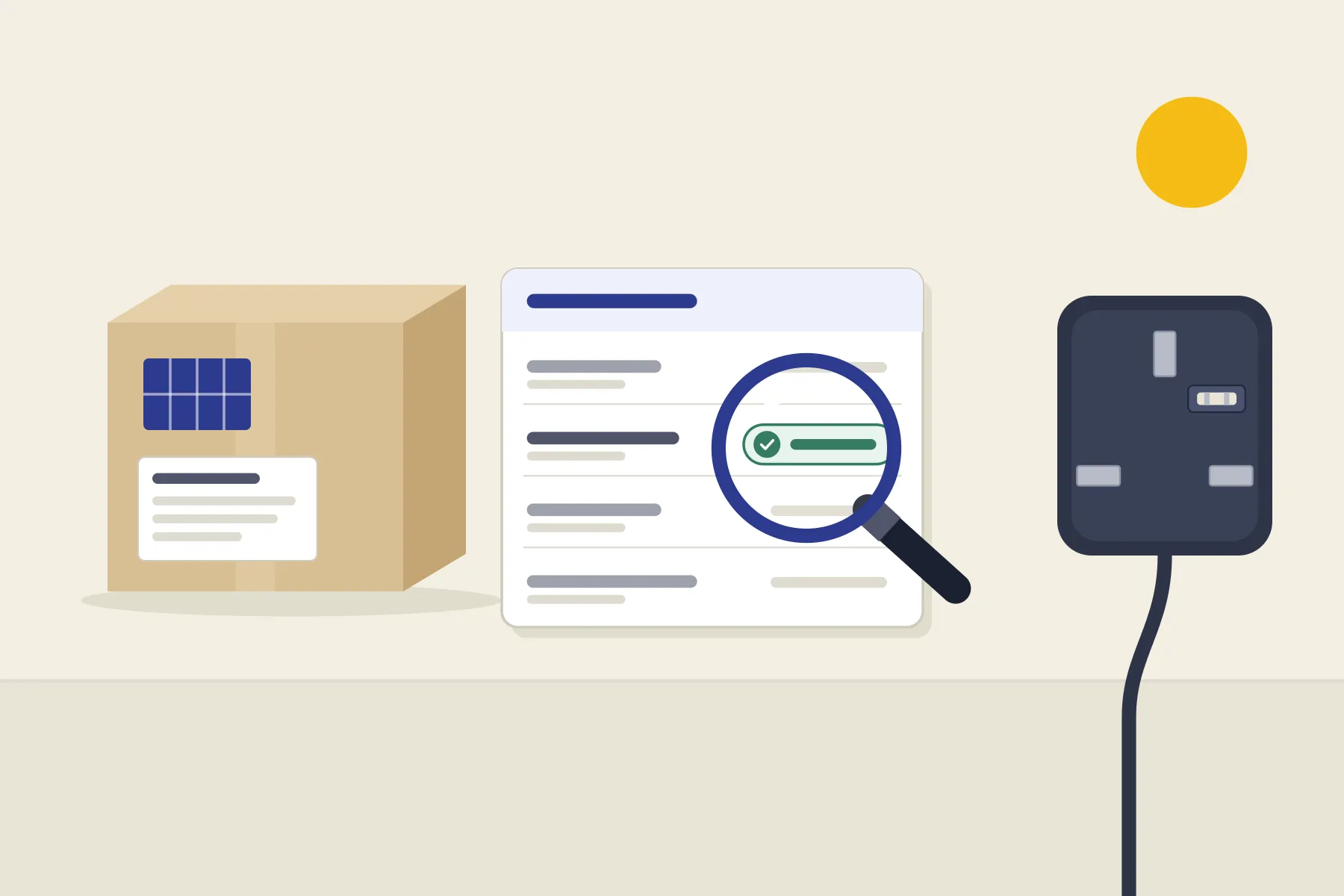
The register check takes a few minutes and needs no login.
ENA register checked: 11 October 2026. Every check below comes from the government’s Plug-in Solar Device Interim Product Specification, version 2 (July 2026). Full rules: is plug-in solar legal in the UK?. Written from official sources; we have not tested kits ourselves (evidence: researched).
The four checks
| # | Check | Where to look | Pass if… |
|---|---|---|---|
| 1 | UK spec statement | Box, product label, listing, manual | It states compliance with the Plug-in Solar Device Interim Product Specification (version 2) |
| 2 | ENA register | ENA Type Test Register (free, no login) | The exact model shows status Compliant |
| 3 | Plug and fuse | Photos of the plug, spec sheet | Moulded, non-rewireable 13 A plug with a fuse of 5 A or less |
| 4 | Complete kit | “What’s in the box” | Mounting system included, plus a label for your consumer unit |
Check 1: the UK spec statement
The specification requires the product to be marked with a statement that it complies with the specification (DESNZ product spec v2). Look for the full name, “Plug-in Solar Device Interim Product Specification”, on the box, label or manual, or in an online listing’s specifications or downloads.
Watch the version. The first version (June 2026) has been withdrawn by the government (gov.uk, plug-in solar consultation). The law refers to version 2, published on 16 July 2026. A kit that only claims version 1, or only mentions a European standard, hasn’t shown it meets the UK rules.
What doesn’t count on its own: a CE or UKCA mark, “800 W” in the title, or the word “legal” in the listing.
Check 2: “Compliant” on the ENA Type Test Register
Every legal kit must be type-tested to the G98 network standard and shown as “Compliant” on the Energy Networks Association’s Type Test Register before it can be sold. Being listed isn’t enough on its own: the entry has to say Compliant (DESNZ product spec v2).
The spec says a manufacturer submitting a kit for registration does not, by itself, show the kit is compliant. Kits can sit on the register as “Non-compliant”, so read the status, not just the name.
As of 11 October 2026, the ENA register listed 133 plug-in solar entries: 120 Compliant and 13 Non-compliant, with Compliant kits from about 26 manufacturers (ENA Type Test Register). Entries are added and changed, so always check the exact model yourself.
How to search the register
- Open the register. Go to the ENA Connect Direct Type Test Register, filtered to plug-in solar. No account or login is needed. The Energy Saving Trust’s guidance links to the same register.
- Check the filter. The list should show Type: Plug-in Solar. If you land on the ENA Connect Direct home page instead, choose “Search the ENA Type Test Register”, then Filters, then Type = Plug-in Solar.
- Search by manufacturer or model name.
- Match the exact model number on the box or listing with the model in the register entry. Each entry shows a reference, the manufacturer, the model and a status. References follow a pattern like
MAKER/NNNNN/V1/A2: a short manufacturer code, a number, then version details (some have no final part). - Read the status. It must say Compliant. “Non-compliant”, or no entry at all, means the kit isn’t covered.
- Note the reference and the date you checked, and keep a screenshot.
Watch for near-identical models. Different versions of the same kit (for example, with or without a mounting kit) have separate entries. As of 11 October 2026, one manufacturer listed standard and “flat roof” versions of the same kit as separate entries. Make sure the version you’re buying is the one marked Compliant.
Check 3: the plug and fuse
The spec sets out the plug in detail (DESNZ product spec v2). A compliant kit has:
- a moulded, non-rewireable 13 A plug (BS 1363) that you can’t open
- a fuse of 5 A or less (BS 1362), not the 13 A fuse you’d find in a kettle plug
- partially insulated pins, like any modern UK plug
- extra protection against touching live pins once unplugged: a mechanical shutter or lock, or an electronic cut-off that removes dangerous voltage within 2 seconds
The rating label should show an output of no more than 800 W. A legal kit’s inverter can feed at most 800 W into your home’s wiring; the product spec also caps it at 800 VA and 3.5 A.
Check 4: a complete kit with mounting and labels
Under the spec, a kit has at least one panel, a grid-following inverter, a lead with a BS 1363 plug and a mounting system for the panel (DESNZ product spec v2). Check for:
- A mounting system in the box, designed for wind and snow loads. The government’s product spec describes a plug-in solar kit as panels, inverter, plug lead and a mounting system, with the maker showing by calculation that the mount is safe. Some kits on the ENA register are listed as “mounting system not included”. The register checks the network side, not the mount. We only recommend kits that come with the manufacturer’s own mounting system. If you’re looking at a kit without one, check that the same maker sells a version “with mounting system” and buy that instead.
- Fixings that are part of that system. Mounting that relies only on cable ties, rope, string, tape, bungee cords or straps is not allowed. If you need a balcony, wall or ground mount, check that version is the one you’re buying, and the one on the register. More in our balcony solar guide.
- A consumer-unit label to stick at or near your fuse box, showing a plug-in solar device is connected.
- A label on the plug or lead saying one device per household circuit, its rated current, and a warning not to use an extension cable, multi-way adaptor or RCD adaptor.
- Instructions in English covering how to identify your circuit, testing your RCD, permissions, planning, insurance and how to register the kit, with a link or QR code.
Other spec points worth checking
Harder to check from a listing, but a good spec sheet will show them (DESNZ product spec v2).
| Spec point | Requirement |
|---|---|
| Panel power | Up to 2,000 W in total |
| Number of panels | Up to four; no more than two in series |
| Panel voltage at inverter | No more than 120 V DC (open circuit) |
| Y-connectors | Not allowed |
| Outdoor parts | At least IP55 (indoor-only parts better than IP44). If you add an outdoor socket, the Energy Saving Trust advises at least IP65, fitted by a qualified electrician |
| Panel fire rating | Backsheet equivalent to Euroclass B-s3, d2 |
| Power cut | Inverter disconnects within 100 ms if the grid goes down |
| Effect on your RCD | Smooth DC leakage to the mains no more than 5 mA |
How panel watts and the 800 W cap fit together: the 800 W limit explained.
If your kit has more than 960 W of panels, the official spec says you should consider having a qualified electrician check your wiring first.
Red flags on a listing
| Red flag | Why it matters |
|---|---|
| “800 W” headline, but the inverter’s rated output is higher | The legal cap is on inverter output: 800 W / 800 VA / 3.5 A |
| “Battery included”, “battery-ready” or “solar + storage” | Kits with a built-in or add-on battery are not covered by the rules |
| Y-connector or “splitter” cables in the box | Y-connectors are banned by the spec |
| Panels held on by straps, cable ties or bungee cords | Mounting that relies only on these isn’t allowed |
| No mention of the Interim Product Specification | Check 1 fails |
| Model number not on the ENA register, or listed as Non-compliant | Check 2 fails |
| A non-UK plug, or a plug adaptor in the box | The spec needs a moulded BS 1363 plug; adaptors are banned |
| No English instructions, or no link or QR code for registering | Required by the spec |
| More than four panels, or panel total over 2,000 W | Outside the spec |
On batteries: plug-in batteries, and plug-in solar kits with a built-in or add-on battery, are not covered and must not be connected under this route (Ofgem G98 decision). Some products appear on the register as solar-only kit configurations: compliant as a solar-only kit, but adding a battery isn’t covered by the current rules.
Where you buy matters too. Electrical Safety First advises households to “avoid buying these devices from third-party sellers on online marketplaces” and to “stick to reputable high street retailers and their online websites” (Electrical Safety First).
Questions to ask the seller
Copy and paste these before you buy:
- Which ENA Type Test Register entry (reference number) covers this exact model, and is its status Compliant?
- Does the product state compliance with the Plug-in Solar Device Interim Product Specification, version 2?
- What is the rated AC output of the inverter, in watts and VA?
- What fuse is fitted in the plug, and is the plug moulded on?
- Is a mounting kit for my surface (railing, wall, ground or flat roof) included, and is that version the one on the register?
- Does the kit include a battery, or connect to one?
A seller of a compliant kit should be able to answer all six.
Already bought a kit that fails checks 1–3?
Don’t connect it. A kit that doesn’t state it meets the spec, isn’t Compliant on the register, has the wrong plug, or has a battery isn’t covered by the new rules. For check 4 (the mounting system), see the note under check 4 above.
For returns or refunds, Citizens Advice has consumer guides (including on returning faulty goods) and a consumer service you can contact (Citizens Advice, consumer advice). We can’t give legal advice on your purchase.
After you buy
- Check your home is ready. The official spec asks for modern residual current protection, such as RCBOs on each circuit; set-ups with ordinary breakers (MCBs) behind a shared RCD “may also be acceptable”, but the government is still testing this. If you have an old fuse box with rewireable fuses, or you’re unsure, get a qualified electrician to check first. Electrical Safety First also recommends at least a Type A bidirectional RCD on the circuit you’ll use; that’s the charity’s advice, not a legal requirement (Electrical Safety First). More in is plug-in solar safe?
- Get permissions. If you rent or live in a leasehold flat, ask your landlord, freeholder or managing agent first, in writing. Tell your home insurer (and your building’s insurer, if you’re in a flat) before you install.
- Install safely. Plug the kit into an ordinary wall socket on a socket circuit. Never use an extension lead, multi-plug adaptor, RCD adaptor or travel adaptor.
- Register before use. Install it, register it, then switch it on (Electricity North West). Register at the UK Plug-in Solar Registration website (myplugin.solar), the link given by the Energy Saving Trust’s government-backed guidance and by network operators. Have your name, postcode, and your kit’s make and model ready, and save or screenshot the on-screen confirmation, because you won’t get an email (EST checklist).
Next step
Want a shortlist of kits that pass these checks? See best plug-in solar kits. New to plug-in solar? Start with the complete guide.
Rules checked: . ENA register checked: 11 October 2026. Northern Ireland: plug-in solar can’t yet be used there. This is general information, not legal or electrical advice. How we research.
Common questions
- Is a kit that's "on the ENA register" legal?
- Only if its entry says Compliant. Kits can be listed as Non-compliant, and being submitted for registration doesn't by itself show compliance.
- Is a German balcony solar kit legal in the UK?
- Only if it meets the UK's Interim Product Specification (version 2), including a moulded UK plug, and the exact model is Compliant on the ENA register. Being legal elsewhere in Europe doesn't count.
- Is a kit with two 445 W panels legal?
- It can be. Kits can include up to 2,000 W of panels (up to four panels), as long as the inverter output stays within 800 VA and 3.5 A and the kit passes the other checks.
- Can I swap the plug for one with a 13 A fuse?
- No. A compliant kit has a moulded, non-rewireable plug with a fuse of 5 A or less. Don't change it.
- Can I use a kit with a battery?
- No. Kits with a built-in or add-on battery, and plug-in batteries, are not covered.
- Does a UKCA or CE mark prove a kit is compliant?
- Not on its own. The checks that show a kit is covered are the statement of compliance with the Interim Product Specification and a Compliant entry on the ENA register for the exact model.
Keep reading
The 800 W limit explained: inverter watts vs panel watts
The 800 W cap is on what the inverter feeds your home, not the panels. How to read a kit's watts, 800 VA and 3.5 A, and what the ENA register shows.
How to register your plug-in solar kit before you use it
Official guidance says registering a plug-in solar kit is a legal requirement, done before you switch it on. Where to register and what you need.
Can you add a battery to plug-in solar in the UK?
No. Plug-in batteries and battery kits aren't covered by the 2026 rules. What the law says, how to spot 'battery ready' listings, and what to do instead.
The Wattleigh Editorial Team researches and writes every guide on this site. We work from official sources (legislation.gov.uk, DESNZ, Ofgem, the Energy Networks Association, Electrical Safety First) and show the date we last checked the rules on each page. Our guides are researched, not hands-on tested.